
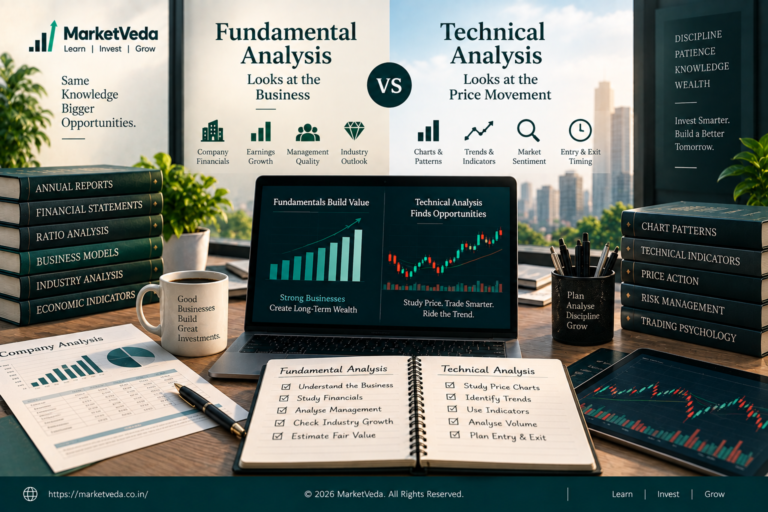
Before buying or selling a stock, investors often study the company and the market.
Two common approaches are fundamental analysis and technical analysis.
Both approaches use different types of information. They can also focus on different questions.
So, what is the difference between fundamental analysis and technical analysis?
Let’s understand both in simple terms.
What Is Fundamental Analysis?
Fundamental analysis focuses on the business and financial health of a company.
It helps investors study factors that can affect a company’s long-term performance.
Some common areas include:
- Revenue
- Profit
- Debt
- Cash flow
- Business model
- Industry conditions
- Management
- Valuation
For example, an investor studying a company may look at its financial statements and business performance.
The goal is to understand the company’s financial position and business prospects.
What Is Technical Analysis?
Technical analysis focuses mainly on price and trading data.
Instead of starting with the company’s financial statements, technical analysis studies market behaviour.
Common tools include:
- Price charts
- Trading volume
- Support and resistance
- Trends
- Moving averages
- Chart patterns
- Technical indicators
For example, a trader may study a stock chart to identify a trend or important price level.
Technical analysis can therefore help market participants study price behaviour and market momentum.
Fundamental Analysis vs Technical Analysis
The key difference is the information each approach focuses on.
| Fundamental Analysis | Technical Analysis |
|---|---|
| Studies business and financial data | Studies price and market data |
| Focuses on company fundamentals | Focuses on market behaviour |
| Often used for longer-term research | Often used for shorter or medium-term analysis |
| Looks at financial performance | Looks at charts and price patterns |
| Includes valuation analysis | Includes technical indicators |
These are broad distinctions. Investors and traders may also combine different analytical methods.
Which Information Does Fundamental Analysis Use?
Fundamental analysis can involve several sources of information.
For example, investors may study:
- Annual reports
- Financial statements
- Earnings
- Debt levels
- Cash flows
- Industry trends
- Company announcements
The aim is to build a clearer picture of the business.
However, strong financial numbers alone do not remove investment risk.
Which Information Does Technical Analysis Use?
Technical analysis mainly uses market data.
This can include:
- Historical prices
- Trading volume
- Trends
- Price levels
- Technical indicators
Charts can help users understand how a security has behaved in the market.
However, past price behaviour does not guarantee future results.
Can Fundamental and Technical Analysis Be Used Together?
Yes.
Some market participants use both approaches.
For example, an investor may first study a company’s financial position.
Then, they may use price charts to understand market trends or potential entry and exit levels.
This can provide two different perspectives.
However, using more tools does not automatically make an investment decision correct.
Risk, valuation, business conditions and market behaviour still need to be considered.
What Should Beginners Learn First?
Beginners can start with the basics of both approaches.
First, understand financial statements and basic company analysis.
Then, learn how price charts work.
After that, explore concepts such as valuation, trends, support and resistance, volume and risk management.
Most importantly, do not rely on one indicator or one financial metric alone.