
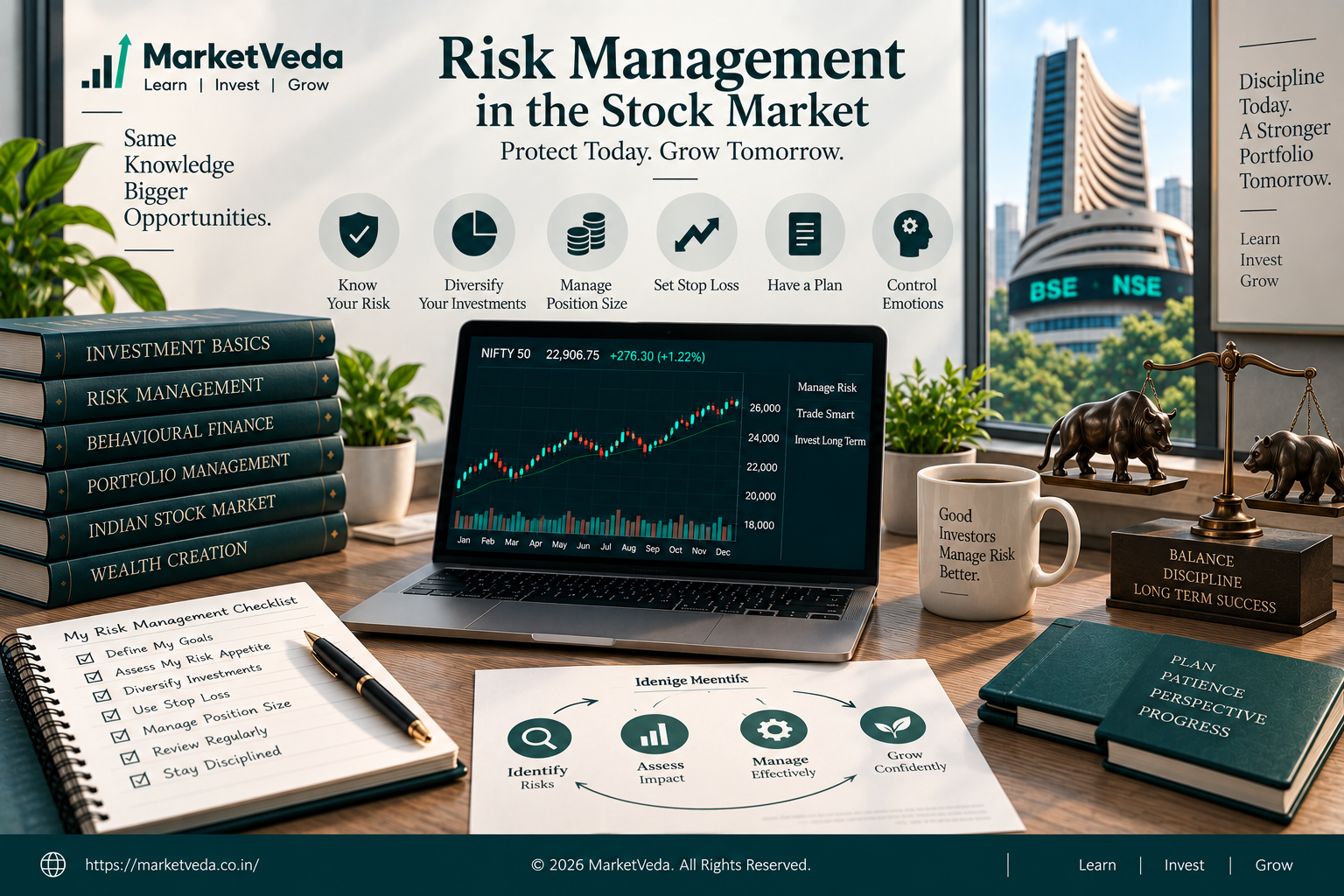
Investing in the stock market can offer opportunities for long-term growth. However, every investment also carries some level of risk.
This is where risk management in the stock market becomes important.
Risk management means understanding possible risks and taking steps to manage them. It does not mean removing risk completely.
For beginners, good risk management can help create a more disciplined approach to investing.
What Is Risk Management in the Stock Market?
Risk management in the stock market is the process of identifying, understanding and managing investment risks.
Stock prices can change because of many factors. These include company performance, economic conditions, market sentiment and global events.
Therefore, investors should not focus only on possible returns. They should also consider what could happen if an investment moves against them.
Why Is Risk Management Important?
The stock market does not guarantee returns.
A stock that performs well today can experience a decline later. Even companies with strong businesses can face unexpected challenges.
Good risk management can help investors:
- Protect their capital
- Avoid excessive concentration
- Make more disciplined decisions
- Manage emotional reactions
- Prepare for market volatility
However, risk management cannot guarantee profits or prevent losses.
Common Types of Investment Risk
Investors can face different types of risk.
Market Risk
Market risk comes from changes in overall market conditions.
For example, broader economic or global events can cause many stocks to decline at the same time.
Business Risk
A company can face problems such as lower sales, higher costs, competition or changes in its business environment.
These factors can affect its financial performance and share price.
Liquidity Risk
Some securities may have lower trading activity.
This can make it more difficult to buy or sell them at the desired price.
Concentration Risk
Concentration risk occurs when too much money is invested in one stock, sector or type of asset.
A negative event affecting that investment can then have a larger impact on the overall portfolio.
How Can Beginners Manage Investment Risk?
There is no single method that can remove investment risk. However, beginners can follow some basic principles.
1. Diversify Your Investments
Diversification means spreading investments across different securities or asset classes.
This can reduce dependence on one investment.
However, diversification does not eliminate market risk.
2. Understand What You Are Investing In
Before investing, learn about the company, industry and investment product.
Look at factors such as:
- Business model
- Financial performance
- Debt
- Valuation
- Industry conditions
- Potential risks
3. Consider Your Time Horizon
Your investment time horizon matters.
Money needed in the near future may require a different approach from money intended for a long-term goal.
Therefore, consider when you may need the money before making an investment decision.
4. Avoid Emotional Decisions
Market prices can move quickly.
Fear can encourage investors to sell in a panic. Greed can encourage excessive risk-taking.
A predefined investment plan can help reduce impulsive decisions.
5. Review Your Portfolio
Risk can change over time.
Therefore, investors should review their investments periodically and check whether they still match their goals and risk tolerance.
Risk Management vs Return
Risk and return are closely connected in investing.
Investments with higher potential returns can also involve higher levels of risk.
However, taking more risk does not guarantee higher returns.
Therefore, investors should consider both potential returns and possible losses before making an investment decision.
Common Risk Management Mistakes
Beginners can sometimes make avoidable mistakes.
Some common examples include:
- Investing based only on tips
- Putting too much money into one stock
- Ignoring investment risks
- Chasing quick returns
- Making decisions because of market panic
- Investing without understanding the product
Learning the basics can help investors approach the market more carefully.