
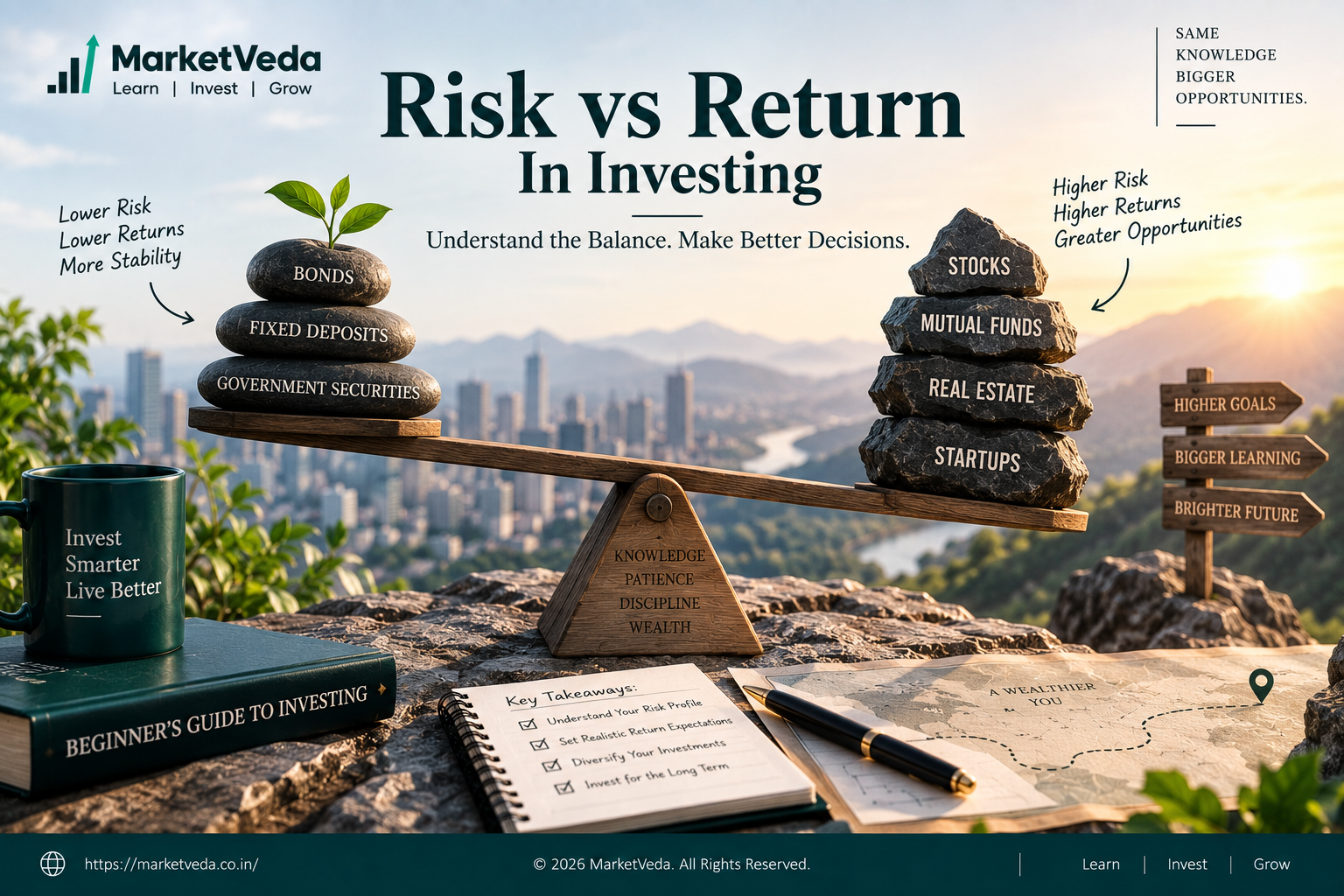
Every investment involves some level of risk.
At the same time, investors usually expect a return on the money they invest.
This creates an important concept called risk vs return.
Understanding this relationship can help beginners make more informed investment decisions.
What Is Risk?
Risk refers to the possibility that an investment may not perform as expected.
An investment can lose value because of several factors.
These may include:
- Market movements
- Company performance
- Economic conditions
- Interest rate changes
- Industry developments
The level and type of risk can differ between investments.
What Is Return?
Return is the gain or loss generated by an investment over a particular period.
For example, suppose you invest ₹10,000 in an asset.
If its value becomes ₹11,000, the investment has gained ₹1,000 before considering applicable costs and taxes.
Returns can come from different sources, such as changes in market value or income generated by an investment.
However, returns are not guaranteed.
What Does Risk vs Return Mean?
The basic idea behind risk vs return is that investors generally expect greater potential returns when taking greater levels of risk.
However, higher risk does not guarantee higher returns.
An investment with higher potential returns may also experience larger losses.
Therefore, investors should consider both the possible return and the possible downside.
Simple Example of Risk vs Return
Consider two hypothetical investments.
Investment A
- Lower expected return
- Lower level of risk
Investment B
- Higher potential return
- Higher level of risk
Investment B may offer greater growth potential.
However, it may also experience larger price movements.
This is why investors should not select an investment based only on its possible return.
Why Is Risk Important?
Ignoring risk can lead to poor investment decisions.
For example, an investor may see an investment with strong past returns and assume that the same performance will continue.
However, past performance does not guarantee future results.
Market conditions can change.
Therefore, investors should understand the risks before investing.
Risk Tolerance Matters
Every investor has a different ability and willingness to handle investment losses.
This is known as risk tolerance.
It can depend on factors such as:
- Financial goals
- Income
- Investment horizon
- Financial responsibilities
- Experience
- Ability to handle losses
An investment that is suitable for one person may not be suitable for another.
Time Horizon and Risk
Your investment time horizon can also influence how you approach risk.
For example, money required in the near future may need a different approach from money intended for a long-term financial goal.
A longer time horizon may allow an investor to handle some market fluctuations differently.
However, a longer time horizon does not remove investment risk.
How Can Investors Manage Risk?
Investors can use several basic risk-management approaches.
Diversification
Spreading investments can reduce concentration risk.
Research
Understanding the investment before committing money can support better decisions.
Asset Allocation
Investors can consider how their money is distributed across different asset classes.
Regular Review
Reviewing investments can help ensure that they continue to match financial goals and risk tolerance.
Risk vs Return: What Should Beginners Remember?
The most important point is simple:
Higher potential return does not mean guaranteed higher return.
Every investment should be evaluated based on both its potential reward and its possible risks.
Investors should also consider their own goals, time horizon and ability to handle losses.