
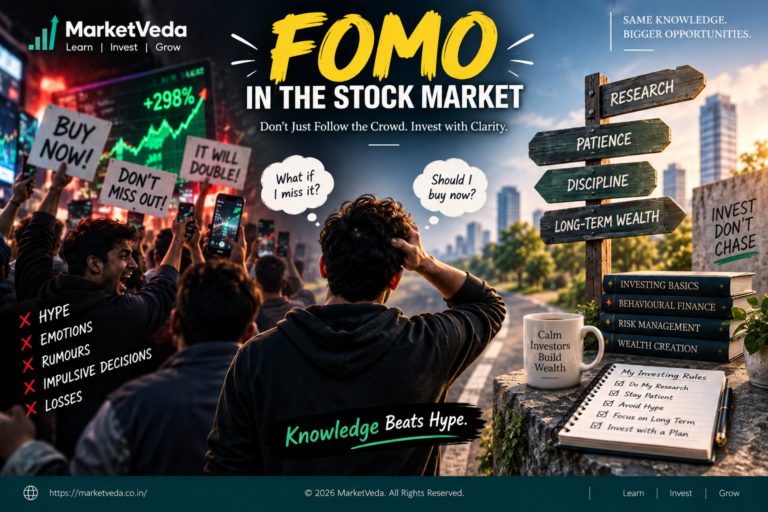
Have you ever seen a stock rise sharply and thought, “I should buy it before it goes even higher”?
That feeling is known as FOMO, or the fear of missing out.
FOMO in the stock market can make investors act quickly. They may buy a stock because everyone else seems to be making money. However, a rising price does not always mean that the stock is a good investment.
FOMO can influence both new and experienced investors. It can also lead to emotional decisions.
Understanding FOMO can help investors make more disciplined choices.
Why Does FOMO Happen in the Stock Market?
FOMO often starts when investors see strong market movements.
For example, imagine a stock rises by 20% in a few days. Social media posts then show people talking about their profits.
You may start thinking that you are missing a great opportunity.
As a result, you may feel pressure to buy the stock immediately.
Several factors can increase FOMO.
1. Social Media
Social media can make market excitement spread quickly.
Investors often see posts about stocks that have recently gained. They may also see screenshots of large profits.
However, these posts may not show the complete picture.
You may see someone’s profit but not their losses or investment strategy.
2. Rising Stock Prices
A rapidly rising stock can attract more attention.
Investors may believe that the price will continue to rise. This can create a cycle where more people buy because others are buying.
The fear of missing the next big move can become stronger.
3. Peer Influence
Friends and family can also influence investment decisions.
If people around you are talking about a particular stock, you may feel that you should invest too.
This can happen even when you have not researched the company.
How FOMO Affects Investor Decisions
FOMO in the stock market can change the way investors evaluate opportunities.
Instead of asking, “Does this investment make sense for me?”, an investor may ask, “What if I miss this opportunity?”
This small change in thinking can have a major impact.
Here are some common FOMO-driven behaviors.
Buying Without Research
An investor may buy a stock after seeing its price increase.
They may not check the company’s financial performance, valuation, business model, or risks.
Chasing Rising Stocks
Some investors buy stocks after a large price increase.
They expect the price to continue moving higher. However, market prices can change quickly.
A stock that has already risen sharply can also experience a correction.
Investing Too Much Money
FOMO can encourage investors to put more money into one opportunity than they originally planned.
This can increase portfolio risk.
Selling in Panic
FOMO does not only affect buying decisions.
If a stock falls after an investor buys it, fear can take over. The investor may sell quickly without reviewing the original investment thesis.
FOMO vs. Disciplined Investing
There is an important difference between FOMO-driven investing and disciplined investing.
FOMO-driven investing often looks like this:
Price rises → excitement increases → investor buys → price falls → panic begins.
Disciplined investing follows a different process:
Research → evaluate → understand risk → decide → review.
The second approach gives investors more time to think before making a decision.
This does not remove investment risk. However, it can reduce decisions based purely on emotion.
How to Avoid FOMO in the Stock Market
FOMO cannot always be eliminated. However, investors can develop habits that help manage it.
1. Have an Investment Plan
Before investing, decide what you want to achieve.
Consider your investment horizon, risk tolerance, and financial goals.
A clear plan can make it easier to ignore short-term market excitement.
2. Research Before Investing
Do not buy a stock simply because it is trending.
Study the company and understand what you are buying.
Look at factors such as:
- Business model
- Revenue and profits
- Debt
- Valuation
- Industry conditions
- Future growth prospects
- Key risks
3. Avoid Decisions Based on Social Media
Social media can provide ideas and information.
However, it should not automatically become the basis for an investment decision.
Always verify important information from reliable sources.
4. Give Yourself Time
You do not always have to act immediately.
If an investment opportunity is genuine, taking time to research it can help you make a more informed decision.
A short pause can prevent an emotional decision.
5. Maintain Diversification
Putting too much money into one stock can increase portfolio risk.
Diversification can help spread exposure across different investments.
However, diversification does not guarantee profits or eliminate losses.
A Simple Example of FOMO
Suppose a stock is trading at ₹500.
You notice that it reaches ₹600 within a few days. People online are discussing how the stock could go even higher.
You decide to buy at ₹600 because you do not want to miss the opportunity.
Soon after, the stock falls to ₹520.
Now you are worried about your investment.
The problem was not simply that the stock fell.
The bigger issue was that the decision was based mainly on the fear of missing out rather than proper research and a defined investment plan.
This example shows why emotional decisions can create unnecessary risk.
The Key Lesson About FOMO
FOMO in the stock market is a psychological reaction, not an investment strategy.
Markets will always provide new opportunities.
You do not need to participate in every market movement.
Instead, focus on understanding the investment, evaluating the risks, and following your plan.
Most importantly, avoid making decisions simply because everyone else appears to be making money.
Conclusion
FOMO in the stock market can strongly influence investor behavior.
Social media, rising prices, and peer discussions can create the feeling that an opportunity must be taken immediately.
However, investing based on fear of missing out can lead to poor research, excessive risk, and emotional decisions.
A better approach is to slow down, research the investment, understand the risks, and follow a clear plan.
Stay informed. Stay disciplined. Invest with understanding.
Follow Market Veda for more educational content on investing, market psychology, financial education, and market insights.
Disclaimer: This article is for informational and educational purposes only. It is not investment advice or a recommendation to buy or sell any security. Investors should conduct their own research and consider their financial goals and risk profile.