
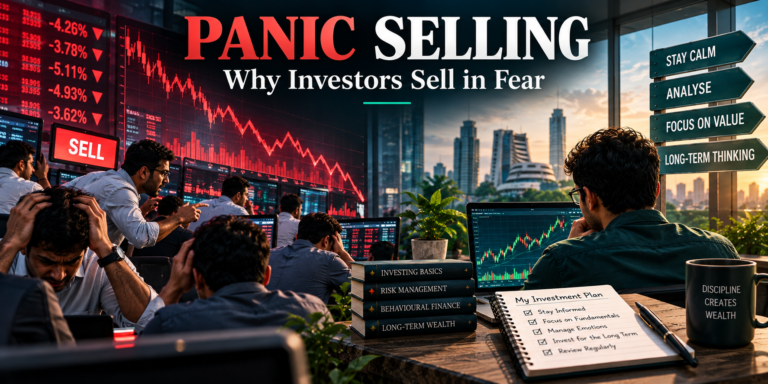
What Is Panic Selling?
Have you ever seen the stock market fall sharply and thought, “I should sell before I lose even more”?
This reaction is known as panic selling.
Panic selling happens when investors sell their investments because of fear or anxiety about falling prices. The decision is often made quickly, without reviewing the original investment plan.
Market declines are a normal part of investing. However, a sharp fall can make investors focus more on short-term losses than their long-term goals.
Understanding panic selling can help investors recognize emotional decisions before acting on them.
Why Do Investors Panic Sell?
Several factors can trigger panic selling.
1. Fear of Losing Money
Seeing the value of an investment fall can be uncomfortable.
An investor may want to stop the loss immediately. As a result, they may sell without checking whether the underlying investment has changed.
2. Negative Market News
Bad economic news, company announcements, or global events can increase uncertainty.
Investors may react to headlines before understanding the full situation.
3. Sudden Market Falls
A sharp decline can create a sense of urgency.
When prices fall quickly, investors may believe that they need to act immediately.
4. Following Other Investors
Panic can spread when many investors start selling.
Seeing other people exit their investments can create additional fear.
This can make an investor think:
“If everyone else is selling, maybe I should sell too.”
How Panic Selling Can Affect Investors
Panic selling can create several problems.
Selling Without Research
An investor may sell because the price has fallen, rather than because the investment has fundamentally changed.
Locking in a Loss
Selling after a decline turns an unrealized loss into a realized loss.
Whether selling is appropriate depends on the investment, financial goals, and circumstances. The key point is that fear alone should not automatically determine the decision.
Missing a Market Recovery
Markets can move in both directions.
If an investor sells during a decline and the market later recovers, they may miss part of that recovery.
This is one reason why reacting to every short-term movement can make investing difficult.
Panic Selling vs. Planned Selling
There is an important difference between panic selling and a planned investment decision.
Panic selling:
Market falls → fear increases → investor sells quickly.
Planned selling:
Investment is reviewed → reasons are evaluated → risks are considered → decision is made.
A planned decision does not guarantee a better outcome. However, it creates a more structured process.
How to Avoid Panic Selling
1. Have an Investment Plan
Know why you are investing before you invest.
Set clear goals and understand your investment time horizon.
This can make it easier to stay focused during short-term market movements.
2. Understand Your Risk Tolerance
Every investment carries some level of risk.
Before investing, understand how much volatility you can reasonably handle.
If a normal market decline causes extreme stress, your investment choices may need to be reviewed.
3. Avoid Checking Prices Constantly
Watching prices every few minutes can increase emotional reactions.
For long-term investors, constantly tracking short-term price movements may create unnecessary stress.
4. Look Beyond the Headline
A dramatic headline can create fear.
Before making a decision, try to understand what actually happened and whether it changes the investment’s long-term outlook.
5. Keep Your Financial Goals in Focus
Your investment decisions should connect to your financial goals.
A short-term market decline does not automatically change a long-term financial objective.
A Simple Example of Panic Selling
Imagine an investor buys a stock at ₹500.
A few weeks later, the market falls and the stock drops to ₹420.
The investor becomes worried and sells immediately because they fear a further decline.
Later, the stock recovers to ₹480.
The investor has already exited the investment and may now face a difficult decision about whether to enter again.
The example shows why emotional decisions during market declines can have consequences.
It does not mean that selling during a fall is always wrong. Sometimes selling can be a reasonable decision when an investment’s fundamentals, goals, or risk profile have changed.
Key Takeaway
Panic selling in the stock market is often driven by fear rather than a structured investment process.
Market declines can be uncomfortable. However, investors can reduce emotional reactions by understanding their risk tolerance, having clear goals, and reviewing information before making decisions.
The goal is not to ignore market risks.
The goal is to make decisions based on information and a plan rather than panic.
Conclusion
Panic selling is a common psychological challenge for investors.
Falling prices, negative news, and market uncertainty can create fear. That fear can lead to quick decisions.
A clear investment plan can help investors stay focused during volatile periods.
Before selling because of fear, take a moment to understand what has changed, review your original reasons for investing, and consider your financial goals.
Stay informed. Stay calm. Think before you act.
Follow Market Veda for more educational content on market psychology, investing, and financial awareness.
Disclaimer: This article is for informational and educational purposes only. It is not investment advice or a recommendation to buy or sell any security. Investors should conduct their own research and consider their financial goals and risk profile.